The Enterprise Agent Challenge
Enterprise AI has hit an inflection point. Gartner projects that 40% of enterprise applications will integrate task-specific AI agents by end of 2026 — up from less than 5% just a year ago. The era of impressive chatbot demos is giving way to domain-specific agents that deeply understand regulatory frameworks, supply chain dynamics, contract law, and customer service workflows.
But there is a fundamental problem standing between enterprises and production-grade agentic AI: how do you safely and quickly expose your internal systems, databases, APIs, and business logic to AI agents without rebuilding your entire infrastructure?
The answer is the Model Context Protocol (MCP) — and it is rapidly becoming the new norm for enabling enterprise AI agents.
What is MCP?
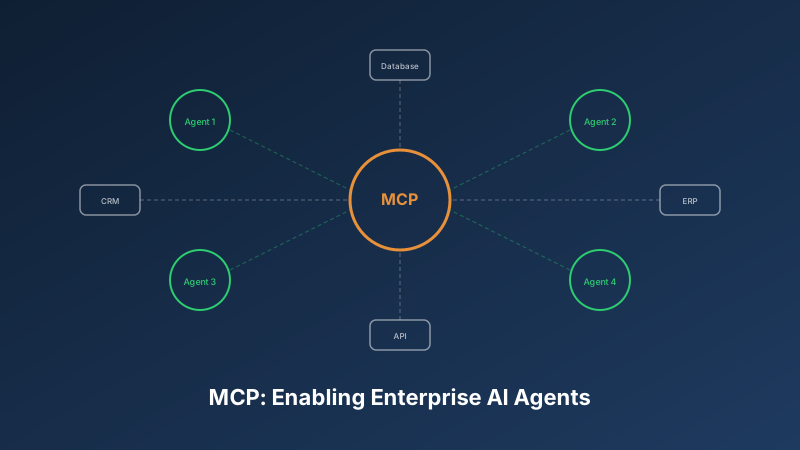
The Model Context Protocol, originally developed by Anthropic, is an open standard that defines how AI models and agents connect to external tools, data sources, and systems. Think of it as a universal adapter — a standardized way for any AI agent to interact with any system, without requiring custom integration code for every combination.
The USB Analogy
Before USB, every device needed its own cable, connector, and driver. Printers, cameras, keyboards — all different. USB created a universal standard, and suddenly any device could connect to any computer.
MCP does the same thing for AI agents and enterprise systems. Before MCP, connecting an AI agent to your CRM, ERP, database, or internal API required custom engineering for each integration. MCP provides a standardized protocol so that:
- Any AI agent can connect to any MCP-enabled system
- Any system can expose its capabilities to any AI agent
- The connection is secure, auditable, and governable
MCP by the Numbers: 2026 Adoption
The adoption numbers tell the story:
- 97 million monthly SDK downloads (Python + TypeScript combined)
- 4,000+ published MCP servers covering SaaS platforms, enterprise systems, development tools, and specialized data sources
- Adopted by every major AI provider: Anthropic, OpenAI, Google, Microsoft, and Amazon
- The de facto standard for model-to-tool communication
These are not experimental figures. MCP has crossed the threshold from emerging protocol to industry standard.
How MCP Enables Rapid Agent Deployment
The Traditional Integration Problem
Without MCP, deploying an AI agent that needs to access your Salesforce CRM, SAP ERP, internal databases, and Slack channels requires:
- Building custom API connectors for each system
- Handling authentication and authorization separately for each integration
- Managing data serialization and deserialization
- Implementing error handling and retry logic
- Building monitoring and audit trails
- Maintaining all of this as systems evolve
For a single agent touching five systems, you could be looking at weeks or months of integration work — and that is before you address security, compliance, and governance.
The MCP Approach
With MCP, the same deployment looks fundamentally different:
- Expose each system as an MCP Server — a lightweight wrapper that describes the system’s capabilities in a standardized format
- Configure the AI agent as an MCP Client — it discovers available servers and their capabilities automatically
- Apply governance policies at the protocol level — access controls, rate limits, audit logging, and human-in-the-loop approvals all happen through the MCP layer
- Deploy and iterate — adding new capabilities means adding new MCP servers, not rewriting agent code
The result: what took months now takes days. What required deep custom engineering now uses a standardized, well-documented protocol.
The 2026 MCP Roadmap: Beyond Tool Integration
The MCP 2026 roadmap, published in March, signals a profound evolution across four pillars:
1. Transport Scalability
Production deployments have exposed real challenges with streamable HTTP, load balancers, and horizontal scaling. The 2026 roadmap addresses these with improvements to transport mechanisms, making MCP viable for high-throughput enterprise workloads.
2. Agent-to-Agent Communication
This is the most significant evolution. MCP is no longer just about connecting models to tools — it is becoming an agent-to-agent communication layer. The roadmap highlights plans for MCP Servers that can act as agents themselves, enabling scenarios like:
- A “Travel Agent” server autonomously negotiating with a “Booking Agent” server
- A “Compliance Agent” reviewing decisions made by a “Lending Agent”
- A “Customer Service Agent” escalating to a “Technical Support Agent” with full context transfer
3. Governance Maturation
Enterprise adoption demands governance. The roadmap includes standardized approaches to:
- Policy enforcement at the protocol level
- Comprehensive audit trails for all agent-system interactions
- Role-based access control for agent capabilities
- Human-in-the-loop approval workflows for high-stakes actions
4. Enterprise Readiness
Features specifically targeting enterprise deployment: service discovery, capability negotiation, versioning, and backward compatibility — the operational concerns that matter when you are running agents at scale.
MCP vs A2A: Complementary, Not Competitive
A common question in the enterprise architecture community: should we use MCP or Google’s A2A (Agent-to-Agent) protocol?
The answer: both. The protocol landscape is clarifying, and the two serve different purposes:
| Aspect | MCP | A2A |
|---|---|---|
| Primary function | Model-to-tool communication | Agent-to-agent coordination |
| Use case | Connecting agents to systems, APIs, and data | Orchestrating multi-agent workflows |
| Analogy | The plug that connects a device to power | The network that connects devices to each other |
The emerging reference architecture for production agentic systems is:
- MCP for tool connectivity and system integration
- A2A for inter-agent orchestration and coordination
- A governance layer on top for policy enforcement, audit, and compliance
This is not unlike the microservices world, where you have gRPC for service-to-service communication, REST for external APIs, and an API gateway for governance — different protocols for different purposes, working together.
Building Secure Agent Infrastructure
The Agent Gateway Pattern
Just as API gateways became essential infrastructure for microservices architectures, agent gateways are emerging as the control plane for multi-agent systems. The formation of the Agentic AI Foundation (AAIF) and products like Solo.io’s AgentGateway reflect a growing category of middleware designed to make agentic systems enterprise-ready.
An agent gateway sits between your AI agents and your MCP servers, providing:
- Authentication and authorization — ensuring agents only access what they are permitted to
- Rate limiting and throttling — preventing runaway agents from overwhelming systems
- Audit logging — recording every interaction for compliance and debugging
- Policy enforcement — applying business rules to agent behavior in real-time
- Human-in-the-loop triggers — escalating high-stakes decisions to human reviewers
Security Considerations
The US federal government has issued a Request for Information specifically targeting AI agent security, signaling that regulators recognize the unique risks of autonomous AI systems. Key concerns include:
- Unauthorized actions — agents performing operations beyond their intended scope
- Data exfiltration — sensitive data leaking through agent tool use
- Prompt injection — adversarial inputs causing agents to behave unexpectedly
- Audit trail gaps — inability to trace agent decisions across multi-agent workflows
MCP addresses these concerns by design. The protocol’s standardized interface means security controls can be applied uniformly across all agent-system interactions, rather than being implemented ad-hoc for each custom integration.
What This Means for Organizations
Getting Started with MCP
For teams exploring MCP adoption, the path typically follows a natural progression:
- Inventory your systems — understand which internal systems, APIs, and data sources your agents would need to interact with
- Leverage the ecosystem — with 4,000+ published MCP servers, many popular platforms already have community or vendor-supported servers available
- Build incrementally — the MCP SDK makes it straightforward to wrap proprietary systems as MCP servers, and you can start with one or two before expanding
- Prioritize governance from day one — the organizations seeing the best results with agentic AI are those that treat governance as a first-class concern, not an afterthought
The Governance Question
Every organization’s context is different, but the governance question is universal. The emerging best practice is to establish your security and audit infrastructure before scaling agent deployments — not after.
The 40% Warning: Why Governance Is Non-Negotiable
Gartner predicts that more than 40% of agentic AI projects will be cancelled by end of 2027 due to escalating costs, unclear business value, or inadequate risk controls. The organizations that succeed share a common trait: they invest as heavily in governance as they do in the agents themselves.
MCP makes governance achievable at scale because:
- Standardized interfaces mean standardized security controls
- Protocol-level audit trails provide comprehensive visibility
- Centralized policy enforcement reduces the risk of governance gaps
- Human-in-the-loop patterns are built into the protocol, not bolted on afterward
Conclusion: MCP Is the Foundation of the Agentic Enterprise
The Model Context Protocol has evolved from a tool integration standard into the foundational infrastructure layer for enterprise AI agents. With 97 million monthly SDK downloads, adoption by every major AI provider, and a 2026 roadmap that addresses the hard problems of enterprise deployment, MCP is not an emerging technology — it is the established standard.
Understanding MCP — how it works, where it is headed, and how it fits into the broader protocol landscape — is becoming essential knowledge for anyone involved in enterprise technology decisions. The protocol is mature, the ecosystem is rich, and the governance patterns are becoming well-established.
The shift from custom integrations to a standardized protocol layer is not unlike what we saw with REST APIs a decade ago. The organizations that understood and adopted that paradigm early gained a lasting structural advantage. MCP represents a similar inflection point for the agentic era.
If you found this helpful or have questions about MCP and enterprise agent architectures, feel free to reach out. I am always happy to discuss these topics.